
Bo1 Upsets and Swiss Formats: Conditional Probability, Not a Universal Edge
A single-map match and a best-of-three series are different probability questions. A favourite with the same stipulated strength on every map can have a higher chance of winning the series than one map. That does not establish a bookmaker error, a profitable underdog or a universal increase in betting variance. Price and payout still matter. This guide uses explicit hypothetical probabilities and a hypothetical Swiss stage to separate format arithmetic from claims that would require actual event rules and a verified dataset.
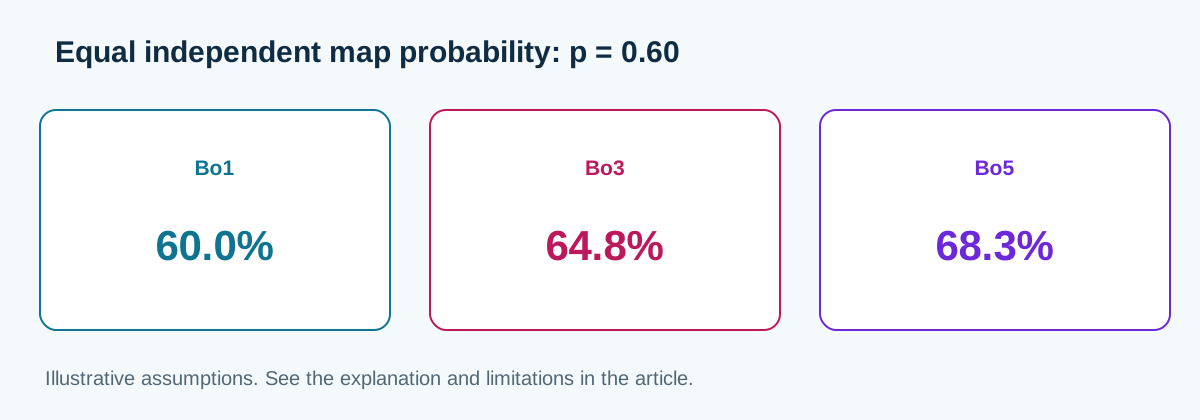
Start with an identical independent-map model. Let p be the favourite's probability on each map. A best-of-one win has probability p. A best-of-three win occurs through two straight wins or through one win in the first two maps followed by a decider win. The formula below follows by enumerating those paths. It does not assume that every real map has the same strength or that roster and tournament information are constant. It is an interpretable baseline, not a complete esports forecasting model.
At a stipulated per-map probability of eighty-four percent, the underdog wins a single map sixteen percent of the time and the best-of-three six point eight six zero eight percent. Their ratio is about two point three three two one. This is a ratio of upset probabilities for that input. It is not a universal MR12 multiplier, a ratio of bankroll variances or a claim that a posted market ignores format. As the input changes, the ratio changes. A large relative ratio can coexist with a small absolute change when the favourite is extremely strong.
Variance and map projections
Binary outcome variance is probability times one minus probability. Betting-return variance also includes the payout, and a portfolio adds stake sizes and dependence. Two events with different win probabilities do not automatically have the same expected return or financial risk. The longer-odds example below stipulates a thirty-percent win probability at decimal odds three and a half. It calculates positive expected return alongside substantial result dispersion. It does not identify an actual market where that probability is true or prescribe a safe stake percentage.
An actual best-of-three can involve different maps and conditional probabilities. A veto projection should record possible remaining maps, their weights and the evidence behind each estimate. The weighted-map example is invented. It demonstrates that a blended probability is conditional on both the weights and the map ratings. New roster information or a different veto can change both. Do not assume that a qualifier always steers the favourite onto a prepared map, or that concentrated preparation guarantees an edge. A map-history count is not a calibrated win probability by itself.
Inverting a series probability to a single-map probability requires the identical-map model. With unequal maps or dependence, many combinations can produce the same series chance. A bookmaker quote also contains margin and is not an established true series probability. Treat a de-margined reference as an estimate and state the method. A series calculator can evaluate supported fixed inputs; it does not infer hidden preparation, automatically reprice a patch or certify the quality of the probability entered. Match its implemented scope to the question.
Counting a Swiss example
The Swiss count below is a tournament-structure example. It assumes sixteen teams, advancement at three wins, elimination at three losses, no withdrawals or byes and compatible pairing within records. Advancement and elimination matches are best-of-three; other matches are best-of-one. Under those assumptions the stage contains thirty-three matches, twenty of them single-map. This is a combinatorial count, not a declaration of the current rules of every CS2 Major or any Dota 2 event. Verify the actual rulebook, pairing constraints and match formats before applying it.
A stage's expected number of upsets is the sum of individual upset probabilities; this expectation does not require independent matches. The chance that every favourite wins does require a joint model. The eight-match example uses independence explicitly. Shared teams across rounds, common information and pairing updates can invalidate a product over a longer stage. Do not turn an expected upset count into a guaranteed number of upsets, and do not compare realized results with a market forecast without preserving the prices, margins and selection process that generated that forecast.
An accumulator also needs its joint probability, accepted combined payout and settlement conditions. Multiplying win probabilities is valid only under the stated independence assumption. The four-leg example has negative expected return at the chosen payout; it does not prove that every accumulator or every short-priced favourite is negative EV. There is no universal one-forty price floor or two-forty underdog threshold. A selection becomes positive expectation only if its defensible win probability and accepted payout support that conclusion after distinct costs.
Review without look-ahead
For a performance review, distinguish information known before placement from events observed afterwards. Conditioning a pre-match selection on who later wins both pistols creates look-ahead if that future result is used to justify the earlier decision. Store roster, map, format, forecast version, accepted price and closing reference with timestamps. Evaluate a subsequent period rather than inventing an opening-round surge dataset. Positive CLV remains a reference comparison, not proof that all observed losses are harmless or that the forecasts are calibrated.
Use format analysis to ask better questions, not to promise survival. A long losing run is possible under the illustrative underdog model, but an expected-run approximation cannot guarantee a ten-loss streak or bound maximum drawdown. Exposure limits are personal constraints, and passing a market is allowed when map probabilities or rules are unclear. Keep the mathematical result, its inputs and its limits together. The finished conclusion may be that the format matters while no bet is justified at the prices actually available.
Worked conditional calculations
Hypothetical identical independent maps, favourite probability p
P_Bo1=p
P_Bo3=p^2+2*p^2*(1-p)=p^2*(3-2*p)
upset_Bo1=1-p
upset_Bo3=(1-p)^2*(1+2*p)
upset ratio M(p)=1/[(1-p)*(1+2*p)]
p=.84: P_Bo3=.931392; upset_Bo3=.068608
M(.84)=.16/.068608=2.332089552239
this is an upset-probability ratio, not a variance multiplier

Hypothetical independent eight-match opening card
favourite probabilities [.78,.74,.70,.68,.64,.62,.58,.55]
expected Bo1 upsets=sum(1-p)=2.71
expected Bo3 upsets=sum(1-p^2*(3-2*p))=2.174434
P(all eight favourites win)=product(p)=.03477728077824
P(first four win)=.2747472
four-leg payout if each accepted odds=1.30: 1.30^4=2.8561
EV per unit=.2747472*2.8561-1=-.21529452208

Hypothetical veto mixture
map weights [.45,.20,.35]; favourite map chances [.60,.66,.78]
blended favourite=.45*.60+.20*.66+.35*.78=.675
underdog=.325; assumed accepted underdog odds=3.50
conditional EV=.325*3.50-1=.1375
if true underdog probability=.28 instead: EV=-.02
weights and map chances are assumptions, not measured calibration

Hypothetical fixed-stake independent underdogs, p=.30, odds=3.50
profit per unit X=2.50 on win or -1 on loss
E[X]=.05; E[X^2]=2.575; Var(X)=2.5725
N=100: loss iff wins<=28; exact binomial probability=.376778179216
N=400: loss iff wins<=114; exact binomial probability=.275804643862
not an exact drawdown probability or a guaranteed losing streak

Hypothetical sixteen-team Swiss, advance at 3 wins, out at 3 losses
no byes or withdrawals; advance/elimination matches Bo3, others Bo1
round one: 8 Bo1; round two: 8 Bo1
round three: 4 Bo1 and 4 Bo3
round four: 6 Bo3; round five: 3 Bo3
total=33; Bo1=20; Bo1 share=20/33=.606060606
check the actual event rules before treating this count as applicable.