Start with fundamentals
Esports Betting Strategy
Quantitative frameworks for beating esports markets: CLV tracking, no-vig fair odds, map handicap pricing, live MR12 economy reads and fractional Kelly bankroll sizing.
Research Pillars
 CS2 Tactical Economy & Round Dynamics
Master MR12 round cascades, loss bonus reset dynamics, force buy break-even rates, pistol conversion probabilities, and side-switch momentum.
 Dota 2 Draft Dynamics & In-Game Valuation
Read drafting win probabilities, net worth lead decay rates, buyback availability states, Roshan timing spikes, and high-ground siege math.
 Esports Market Selection & Odds Valuation
Find mispriced map handicaps vs moneyline odds, player prop ADR variances, decider map probabilities, and latency arbitrage boundaries.
 Line Shopping & Esports Operator Auditing
Rigorously audit 1win vs Stake margin drag, track Closing Line Value (CLV), navigate Tier-2 market liquidity limits, and protect accounts from limits.
 Bankroll Management, Fractional Kelly & Tilt Control
Implement Quarter/Half-Kelly sizing for high-variance esports, establish strict session stop-loss limits, survive Bo1 Swiss chaos, and log EV.
CS2 Betting Strategy: Economy, Map Veto and Series Prices
Evaluate equipment, loss-counter states, map scenarios and settlement under an explicit MR12 model without unsupported side rates or automatic betting triggers.

MR12 economy: loss counters and conditional round models
Separate cash mechanics from win probability. Conditional save/force and round-count examples do not establish a measured betting edge.

Pistol rounds: count, cash and conditional cascades
Conditional pistol-cascade arithmetic, cash branches and totals without invented professional conversion rates.

Map Veto and Pool Depth: Scenarios and Probabilities
Build legal veto scenarios, weight map-specific series probabilities and evaluate pool depth without invented confidence or variance premiums.

CT and T-Side Asymmetry: Conditional Half-Time Pricing
Evaluate an 8–4 half with explicit round assumptions, equipment branches and overtime rules instead of fixed map percentages or guaranteed side-switch edges.

CS2 Overtime Math: A Conditional MR3 Model and Its Limits
Enumerate state-dependent half paths and overtime totals without fabricated win rates, universal cash settings or psychological betting edges.

Round Handicaps vs Totals: Score Sets and Prices
Compare round spreads and totals through explicit score sets, a constructed probability model and side-specific EV rather than fabricated margin averages.

Tactical Timeouts: Evidence, Timing and Conditional Models
Evaluate tactical timeouts with event-specific rules, state-matched evidence and a conditional round-to-map model, without invented coach success rates.
Dota 2 Betting Strategy: Drafts, Gold, Objectives and Buybacks
A practical framework for evaluating drafts, live resources and series prices, with conditional examples and explicit limits on model estimates.

Draft Phase Win Probability: Evaluating Plans and Uncertainty
Assess roles, lane risks, timing and execution without unsupported hero bonuses or claiming that a draft checklist produces a calibrated probability.

Net Worth Lead Decay: Relative Gold and Conditional Probability
Understand relative leads and a hypothetical logistic decay curve without presenting chosen anchors as measured professional win rates.

Buyback State Machine: Late-Game Availability and Dieback Risk
Track each hero's buyback eligibility, cooldown and gold, then test conditional siege scenarios without turning a death into a guaranteed game loss.

Roshan Timing and Aegis: Patch Rules, State and Conditional Odds
Use dated Valve rules, verify the active pit and distinguish hypothetical respawn and probability calculations from measured Aegis value.

First Blood and Race to 10 Kills: Conditional Models for Early Props
Separate the first elimination from a kill race, calculate exact toy probabilities and check margin and settlement without invented hero or regional win rates.

Dota 2 Tournament Meta: Updating Draft Evidence During an Event
Compare hero priority, small samples and changing opponents without assuming a fixed hero-pool funnel, fatigue penalty or bookmaker delay.

Lane State Live Evaluation: Reading Farm, Experience and Pressure
Evaluate the opening lanes with time-aligned observations and conditional calculations instead of universal last-hit thresholds or lane-sweep win rates.
Esports Market Selection: Contracts, Probabilities and Capacity
Define esports betting contracts, compare conditional EV and capacity, and check model uncertainty without fabricated market rankings.

Map Winner vs Series Winner: Probabilities and Prices
Compare map and series contracts through conditional probabilities, actual prices, capital timing and hedge payoffs without an invented backtest.

Player Props: Modeling Kills, ADR and Opportunity
Separate match length, role and performance rates, then test count-distribution assumptions without invented correlations or guaranteed Under strategies.
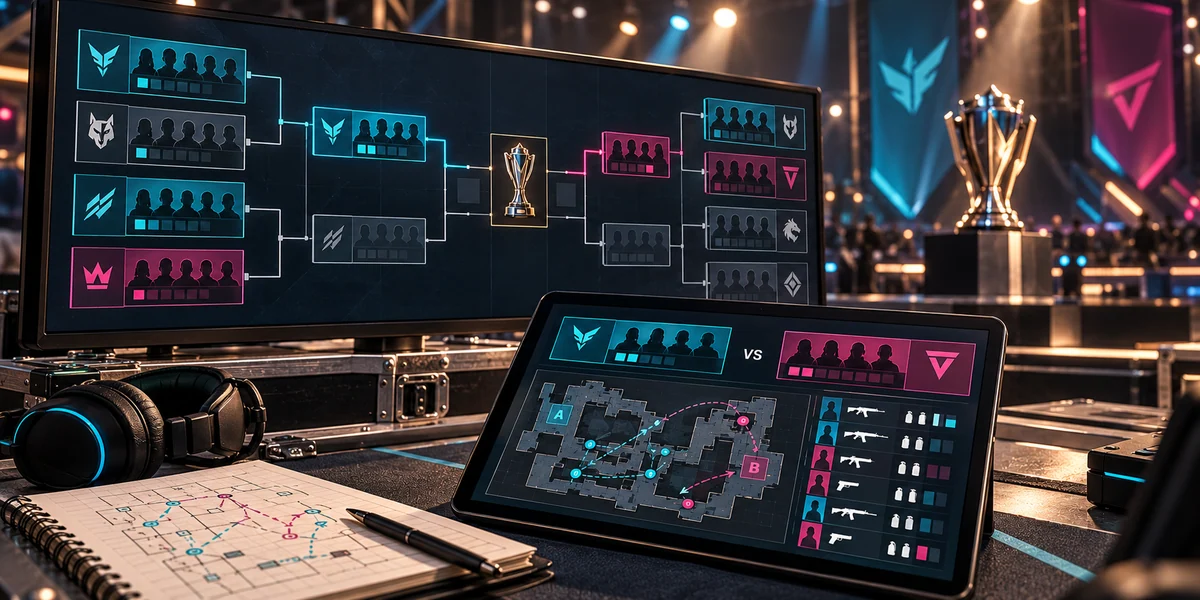
Outrights vs Series: Tournament Paths and Capital
Compare tournament futures and sequential series with complete fields, conditional bracket paths, capital availability and explicit payoff examples.

Bo3 and Bo5 Map Handicaps: Scorelines and Payoffs
Price Bo3 and Bo5 map handicaps with explicit scoreline trees, conditional probabilities and synthetic payoff checks.

Stream delay in live betting: state alignment and conditional models
Separate old video, accepted prices and probability models. Exact tail calculations and selected-sample examples do not establish a real operator edge.

Hedging and Cash-Out: Payoffs, Conditional Value and Execution
Compare cash-out, opposite bets and lays with explicit cash flows; separate expected value, concentration and execution risk.

Exotic Esports Props: Auditing Margin, Rarity and Model Risk
Audit novelty markets with explicit prices and sampling assumptions, without invented frequency tables or claims that rare events are impossible to model.
Esports Line Shopping: Contracts, Prices and Costs
Compare equivalent esports bets, calculate price improvements and costs, and distinguish quoted opportunities from accepted tickets.

1win vs Stake Margin Audit: A Reproducible Comparison Method
Compare accepted esports prices, overround, settlement and costs. Hypothetical examples explain the method without claiming measured operator averages.

Closing Line Value in Esports: Calculation, Benchmarks and Limits
Calculate no-vig CLV, compare de-vig methods and distinguish a better closing-price comparison from true expected value and realized profit.

Lower-Tier Esports: Limits, Lineups and Uncertainty
Evaluate lower-tier esports with observed stake limits, confirmed rosters and explicit uncertainty, without fabricated income or integrity rates.

Esports Bonuses: Rollover, Cash Flows and Limits of EV Screens
Read the actual contract, distinguish credit types and calculate conditional screens without treating completion, cash value or profitability as guaranteed.

Crypto vs Fiat Esports Payments: Costs, Timing and Verification
Compare payment routes with matching endpoints and explicit costs, without unverified speed promises, anonymity claims or reserve allocations.

Sportsbook limits: evidence, accepted stakes and account exposure
Check what a restriction actually means. Separate accepted amounts, price, account terms and withdrawals without unverified camouflage or account-lifetime promises.

Official feeds versus broadcasts: product scope, timestamps and settlement
Check what official data and latency claims actually establish. Event probability, acceptance probability and wager settlement are separate questions.
Esports Bankroll Management: Capital, Units and Explicit Risk Models
Separate affordable capital from exposure, distinguish staking rules, and interpret ruin mathematics only within its stated model.

Fractional Kelly for Esports: Exact Growth and Probability Error
Derive the binary Kelly fraction, distinguish exact log growth from approximations, and test probability error without invented drawdown statistics.

Bo1 Upsets and Swiss Formats: Conditional Probability, Not a Universal Edge
Compare Bo1 and Bo3 under stated assumptions, count a hypothetical Swiss stage and evaluate upset and betting-return probabilities separately.

Tilt After a Bad Beat: Interrupt Chasing and Preserve the Record
Use observable actions and precommitted pauses without fabricated neurobiology, universal clinical timings or CLV-as-proof.

Session Stop-Loss and Win Targets: Define the Actual Boundary
Set explicit session policies, include open liabilities and distinguish spending controls from claims of improved expected value.

Tracking Esports ROI, CLV and Variance Without False Proof
Build a reconciled ledger, separate outcome and price evidence, and calculate yield and uncertainty under explicit assumptions.

Fandom Bias: Pricing Examples and Blind Forecasts
Examine fandom bias with hypothetical pricing, blind forecasts and a documented decision audit, without assuming a universal favourite tax.

Drawdown Recovery: A Decision Protocol Without Recovery Promises
Measure drawdown, calculate loss runs under explicit assumptions, and separate a capital pause from evidence about a model.