
Compare the same contract
A higher decimal price improves the payoff of an otherwise identical bet. That is the useful claim behind line shopping. It does not require a claim that one operator is always slower, cheaper or friendlier to winning customers. Start with the contract: the team, series format, map number, overtime treatment, start time and settlement rules. Two prices beside the same team name may refer to different events. A regulation-only result and a result including overtime cannot be substituted just because one number is larger.
1. The Financial Mathematics of Line Disparities
The break-even win rate for any decimal price d is simply 1/d:
- At 1.90, you must win 52.63% of your bets just to stop losing money.
- At 1.95, the threshold drops to 51.28%.
The return on investment uplift is equally clean. For any bettor with true hit rate p, expected ROI is p × d − 1. The ROI improvement from a price increase of Δd is therefore p × Δd.
If you are betting at fair value, p ≈ 1/d. The uplift then approximates Δd / d. This produces the key result for professional shoppers: the same 0.05 improvement is worth more on shorter prices.
- At coin-flip prices around 1.90: an extra 0.05 adds roughly 2.6% ROI.
- On a heavy favourite around 1.32: the same 0.05 adds roughly 3.8% ROI.
The near-fair examples above use an assumed probability close to the reciprocal of the original price. They are not measured returns for all esports bets. With the same probability p = 0.52, moving from 1.90 to 1.95 changes expected ROI from −1.2% to +1.4%, an improvement of 2.6 percentage points. A worse estimate of p can leave both prices negative. Buying the better price reduces a loss in that case; it does not establish an edge.
p = 0.52; stake = 100; hypothetical W = 260, L = 240
ROI(1.90) = 0.52 * 1.90 - 1 = -0.012
ROI(1.95) = 0.52 * 1.95 - 1 = +0.014
profit(1.90) = 260 * 90 - 240 * 100 = -600
profit(1.95) = 260 * 95 - 240 * 100 = +700
difference = 260 * 100 * 0.05 = 1300
Margin and a reference estimate
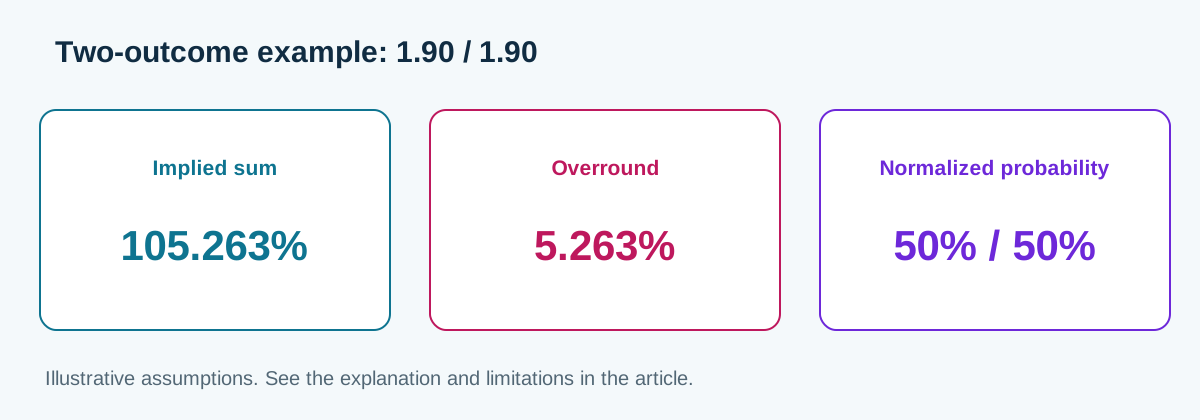
Record both sides of a complete two-outcome market at the same timestamp. Let S = 1/dA + 1/dB. Overround is S − 1, while 1 − 1/S is a theoretical hold for balanced liabilities, or an expected loss under proportional margin loading and correct underlying probabilities. It is not the realised loss on every ticket. At 1.90 on both sides, overround is 5.263158% and theoretical hold is 5%, not 4.76%. At 1.95 on both sides they are 2.564103% and 2.5%.
Dividing each reciprocal price by S gives a proportional no-vig reference. Additive removal distributes the excess equally across outcomes. Different removal methods can produce different estimates from the same quotes; none observes the true chance of winning. A reference operator is a comparison source, not an oracle. Compare several independent sources where available, and record the method. A disagreement may reflect different rules, stale timestamps, liability or information missing from your model. Do not automatically label the longest quote a trading error.
Equivalent outcomes and execution
In a completed ordinary Bo3 without a map advantage, Team A +1.5 maps and Team B to win 2-0 are complements. The sum of their reciprocal prices tests a hypothetical two-leg hedge. At 1.45 and 2.65 the sum is 1.067013, so there is no arbitrage. At 1.68 and 2.65 it is 0.972597. Equal-return allocation would pay about 1.028175 times the total stake in either completed outcome, before costs. This calculation assumes both legs are accepted in full and share compatible settlement rules.
That is a payoff identity, not a promise of risk-free execution. One leg can be repriced, rejected, partially filled or voided. A forfeit may trigger different clauses at different operators. Check the state-by-state net result, including the case in which just one leg remains. Do not add money merely to complete an intended hedge at a now-unfavourable price. A quoted opportunity and an accepted set of tickets are different objects. Save the confirmation prices and accepted stakes rather than treating a screenshot of the market as a completed trade.
Fees, available capital and the decision log
Subtract costs according to the cash flow they actually affect. A fixed transfer charge, a spread on conversion, a fee on net winnings and a fee on the entire withdrawal require different formulas. For a simple one-bet example, stake 100, probability 0.52 and price 1.95 give expected gross profit 1.40. An additional fixed cost of 2 paid regardless of outcome changes that expectation to −0.60. Cycling deposits more often does not erase risk and is not a reason to create extra betting volume. Compare net expected money with the option to do nothing.
Maintain a record of accessible balances, unsettled stakes and transfers in progress. Do not count the same money twice across wallets and pending withdrawals. No universal account count, allocation percentage, withdrawal schedule or account lifetime follows from line-shopping mathematics. Use only accounts and access permitted by the relevant rules. There is no need to place camouflage bets, randomise stakes or imitate another customer profile. Those actions spend money without establishing that prices are good. An unavailable market is simply unavailable; a larger bankroll cannot make a rejected stake executable.
For each candidate, save the timestamp, complete opposing prices, contract, estimated probability, uncertainty range, costs, requested stake and accepted stake. Recalculate EV at the confirmed price. Later, compare the entry with a recorded closing benchmark using a stated margin-removal method. Positive closing line value shows a price difference against that benchmark, not a proven positive true expectation. Audit missing and rejected bets as well as accepted ones. Otherwise the log silently selects the opportunities that happened to survive execution. The useful outcome is a reproducible decision, including a clear reason to pass.
A comparison sheet also needs an expiry rule. If the lineup, veto or quoted price changes, the earlier calculation is no longer an instruction to place the bet. Keep the earlier row for the audit, add the new information and make a new decision. This avoids retrospectively combining the probability from one match state with the price from another. A historical screenshot can illustrate a calculation; it cannot establish that the quote was available at your requested stake.
Finally, compare only opportunities you can actually evaluate. Adding more operators and alerts increases the number of quotes, not the quality of the underlying probability. Start with a small set of equivalent contracts and verify the records by hand. Expand the comparison only when settlement and cost differences are understood. A missed price is not a loss that must be recovered on the next fixture. If the net calculation is unclear, retaining the money is a complete decision.
Related reading
- Esports Odds & Margin Drag Converter
- Esports Bankroll Tracker & Kelly Unit Sizer
- Esports Bankroll Tracker & Kelly Unit Sizer
- account limitation prevention guide
- Esports Odds & Margin Drag Converter
- 1 win vs Stake margin audit
- tier-2 liquidity and betting limits
- Esports Bankroll Tracker & Kelly Unit Sizer
- closing line value guide
- account limitation prevention guide