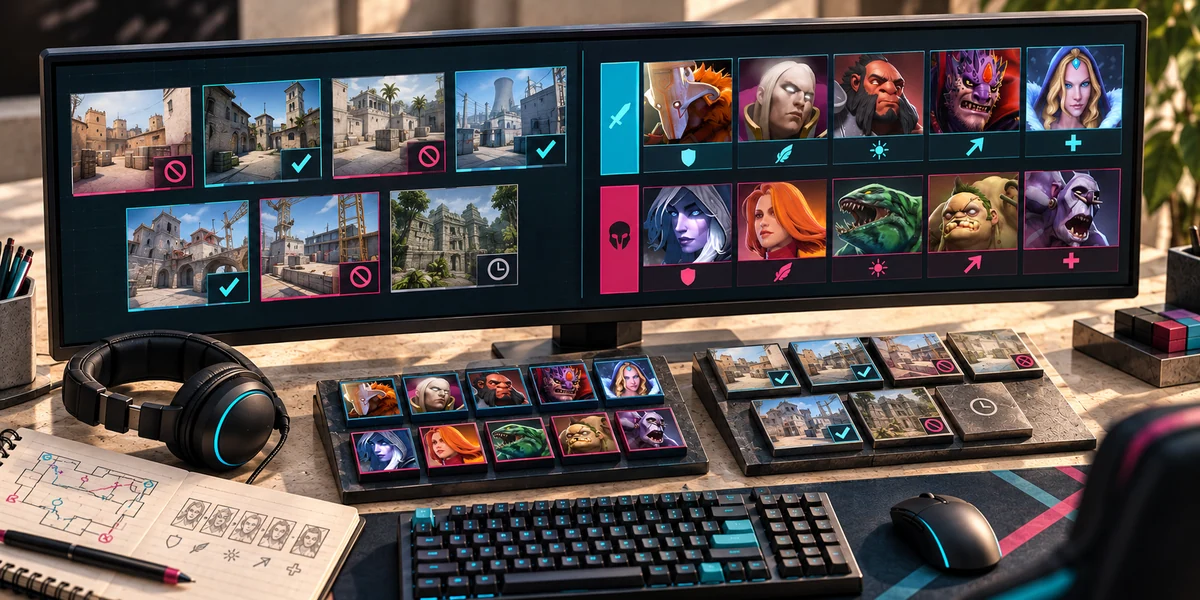
Step 2: Map Vetoes and MOBA Drafts as Model Inputs
A confirmed map pool changes the question you are estimating. Start from the event rules, team rosters and available information, then calculate a conditional price. A positive CLV record from 100 bets does not prove that either the underlying model or the next prediction is correct.
CS2 map selection and MOBA drafts affect which matchups will be played. They do not determine a published fixed share of the outcome here: no dataset supports a universal 40% contribution or a fixed probability gain from a counter-pick. All numerical inputs below are hypothetical, not measured team histories.
Key Takeaway: Vetoes and drafts change the conditions of a model. A correct combination formula does not validate its inputs or prove a betting advantage.
Part 1: CS2 Map Veto Mechanics and Perma-Ban Leverage
The following is an example Bo3 veto procedure for a seven-map pool. Check the actual tournament's map set, selection rights, side-choice rules and sequence before applying it. An illustrative sequence is not a statement that every Valve, ESL or BLAST event uses identical rules.
- Team A bans one map (Ban 1)
- Team B bans one map (Ban 2)
- Team A selects Map 1 (Pick 1)
- Team B selects Map 2 (Pick 2)
- Team A bans a second map (Ban 3)
- Team B bans a second map (Ban 4)
- The remaining unbanned map becomes Map 3 (Decider)
A perma-ban is a map a team habitually avoids in the observed sample. That pattern is evidence about earlier choices, not a commitment about the next match. A roster change, new patch, opponent or a prepared surprise can alter the decision. Use a generic Map X in the examples rather than assuming an old named map remains in the current pool.
- Shared avoidance: both teams have avoided Map X. Either may expect the other to ban it, but the sequence and a surprise selection still matter. Neither is automatically forced to spend the first ban.
- Asymmetric avoidance: Team A avoids Map X while Team B often bans Map Y. Leaving X open is a strategic risk, not a certainty that B will decline it. Model both responses and the quality of the underlying samples.
The effect of a veto must be estimated through the resulting map probabilities. No measured 18–24% series penalty is established here. Consider the possible responses of both captains and compare several plausible pools rather than assigning an automatic advantage to one observed ban. Map Veto and Pool Depth Dynamics
HYPOTHETICAL INDEPENDENT MAP INPUTS
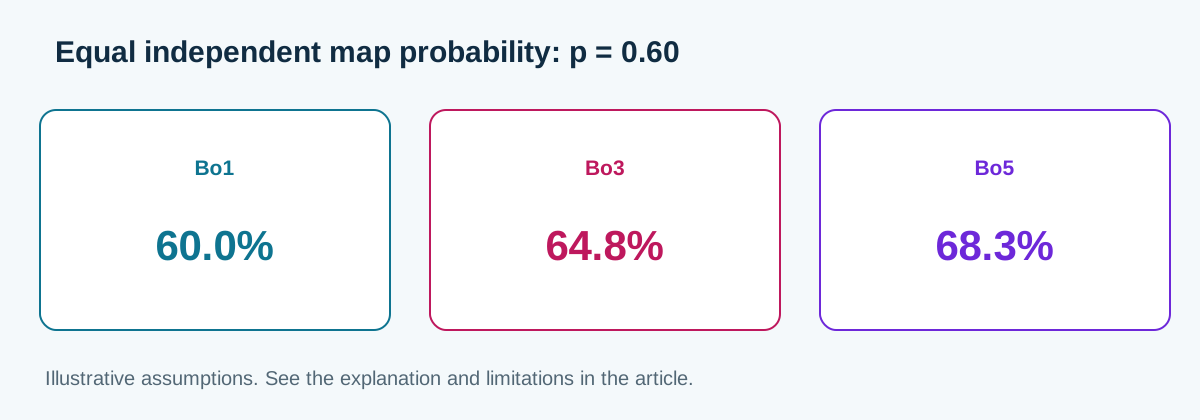
A: p1=0.76, p2=0.48, p3=0.68
P(A 2-0) = 0.76 * 0.48 = 0.3648
P(B 2-0) = 0.24 * 0.52 = 0.1248
P(1-1) = 1 - 0.3648 - 0.1248 = 0.5104
P(A) = 0.3648 + 0.5104 * 0.68 = 0.711872
P(B) = 0.288128
1/P(A) = 1.4047
1/P(B) = 3.4707
EV(A @1.25) = 0.711872 * 1.25 - 1 = -11.016%
EV(B @3.95) = 0.288128 * 3.95 - 1 = +13.81056%
P(B +1.5) = 1 - P(A 2-0) = 0.6352
In the hypothetical independent-map calculation, Team A's series probability is 71.1872%. Team B's moneyline at 3.95 has +13.81056% EV only if those inputs are adequate probabilities. Team B +1.5 maps is a different event with probability 63.52% in this model; without its own quote, its EV is unknown. Series Win Calculator
A draft can suggest early pressure or later scaling, but there is no universal requirement to lead by 8,000 gold at minute 20 or 22. Evaluate actual lanes, items, levels, objectives and the opponent's response. Reaching minute 35 does not automatically turn a 70% estimate into less than 20%. Draft Phase Win Probability in Dota 2
Part 2: Dota 2 Draft Architecture - Pick Order and Counters
Read the pick-and-ban structure of the event's mode and patch. In a standard five-versus-five draft there are ten selected heroes in total. The last hero selection is not a twelfth pick. First-pick rights and the ability to respond should be evaluated in the actual selection order, not inferred from a universal win-rate threshold.
- First pick: evaluate which heroes remain available and how selecting one constrains the rest of the draft. First pick does not guarantee a hero with a 65% future win probability.
- Last pick: an unanswered selection may expose a matchup issue, but the whole lineup and player roles still matter. No fixed probability follows from the hero name alone.
A counter-pick is a hypothesis about a matchup, not a guaranteed 75% winner. Check player proficiency, roles, the complete lineup and the event patch. Observing a draft on a broadcast also does not establish that the bookmaker receives the information later or takes several minutes to update.
| Factor | Game | Input to check | When | Use |
|---|---|---|---|---|
| Veto | CS2 | Confirmed pool and rosters | Actual confirmation | Update map inputs |
| Last pick | Dota 2 | Roles and matchup assumptions | Actual draft | Reassess the estimate |
| Tempo and scaling | Dota 2 / LoL | Observed items and objectives | Observed game state | No fixed gold threshold |
| Pool overlap | CS2 | Map-specific probabilities | After confirmation | Calculate, do not assume a 50% decider |
Part 3: Speed of Execution on Official Veto Submissions
Publication and veto timing vary by event. Record when the organiser or a match page actually confirmed the maps. Do not assume a universal submission 45–90 minutes before play or publication 20–30 minutes before a broadcast. A third-party listing is a source to check, not automatically the organiser's official record.
A video stream, match page and market may reflect different moments. Compare timestamps and whether the quote can actually be accepted. Confirmation can reduce uncertainty about the pool without leaving any exploitable stale price available. If a source conflicts with the organiser, retain the conflict rather than selecting the convenient version.
A move from 1.75 to 1.48 would be a price observation, not proof that the first bet had positive true EV. Document the actual quotes and timing; do not manufacture a historical move to illustrate an opportunity. Closing-line comparison and model calibration answer different questions. Closing Line Value Mastery
Before confirmation, model several possible pools and their uncertainty. After confirmation, update the inputs and compare the accepted quote with the resulting estimate. Waiting may change both information and price; neither timing choice guarantees value. There is no requirement to place a bet when the remaining uncertainty is too large.
Part 4: The Pre-Match Tactical Veto Checklist
Use this checklist to preserve the reasoning and make later errors diagnosable. Keep the observed information separate from assumptions and record the version of the model. Test predictions on later matches rather than selecting a successful example after the result.
- List possible veto sequences from the current map set and recent roster-specific observations. State what would change the projection.
- Estimate each map probability with sample size, opposition, sides, patch and roster in view. A raw historical win fraction is not automatically the matchup probability.
- Combine explicit map probabilities into the conditional series model. Keep model uncertainty separate from arithmetic and use the converter to check the quote. Esports Odds Converter
- After verified confirmation, update the pool and timestamp, then inspect the current accepted price. Do not assume a fixed publication window or a guaranteed chance to execute.
Keep a record of the information sequence
Record the format and event rules, the information available before the veto or draft, the confirmed selections, your revised probabilities and the quote timestamp. Keep the initial estimate instead of replacing it after the last pick. If a probability was conditional on an expected map that was banned, mark that forecast as superseded. A price from before the announcement and a model using later information do not establish an executable advantage.
When reviewing the result, distinguish a mistaken input from a correctly described uncertain outcome. A team losing at an estimated 70% does not alone invalidate the estimate, just as one winner does not prove the draft analysis. Check a pre-defined set of comparable forecasts, record changes in lineup and patch, and evaluate on later events. If the sample cannot support a numerical effect for a particular matchup, leave that effect unresolved rather than assigning a universal percentage to the final pick.