
Step 3: Quantitative Esports Models, CLV and Kelly
Treat a quantitative model as a prediction to test, not a professional status earned after 100 bets. Keep three outputs separate: the probability estimate available at the decision, the accepted price and the eventual result. A good-looking sequence or closing-price comparison does not validate all three.
This guide combines a price benchmark, a conditional staking formula and a model-review process. They answer different questions. Neither a formula nor a particular execution pattern guarantees profit or continued access to an operator's quoted stakes.
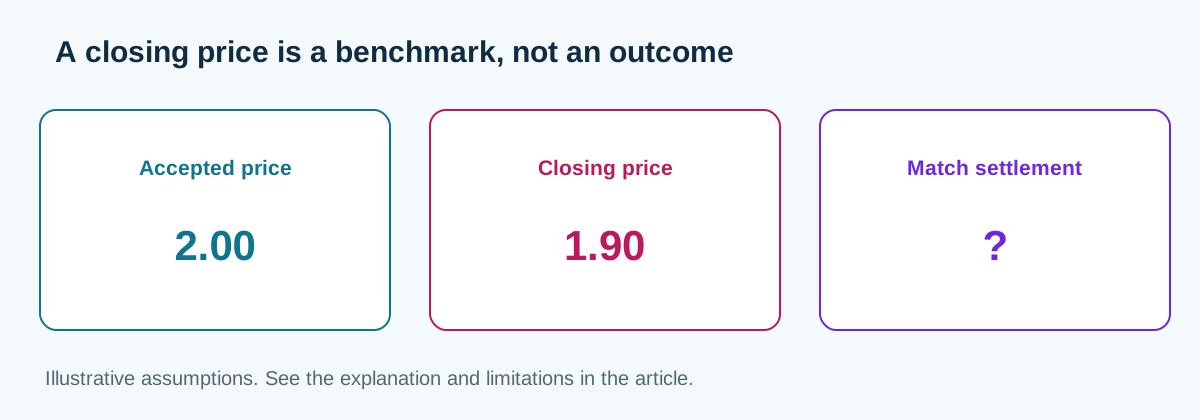
Key takeaway: CLV compares your price with a closing benchmark. Its interpretation depends on the quality of that benchmark. A positive CLV does not establish the true outcome probability or guarantee a profit over any fixed number of bets.
Part 1: CLV as a Price Benchmark
Closing prices summarize the information and trading available in a particular market. They can be useful benchmarks, but may reflect thin liquidity, stale information or shared modeling errors. Removing the margin produces a market estimate, not an independently measured true probability. Compare the same selection, settlement rules and timestamp; a different market is not a valid closing-price comparison.
CLV compares the accepted price with a defined closing benchmark under a stated margin-removal method. Preserve the benchmark's timestamp and contract. Do not assume it includes every informed trade or equals the unknown true probability.
// PRICE COMPARISON, NOT A PROFITABILITY PROOF
CLV (%) = (1.72 / 1.55 - 1) * 100 = +10.97%

// Expected return needs a separate probability assumption.
If p_true = 0.55:
EV = 0.55 * 1.72 - 1 = -0.054 = -5.40%

// The closing price is a benchmark, not a known p_true.
// No confidence level or ROI interval is inferred from CLV alone.
The example separates two calculations. The price ratio gives CLV of +10.97%. Expected return instead requires a true win probability: EV = p × odds_taken - 1. If p were 0.55, a price of 1.72 would have EV = -5.40% despite the positive CLV. This counterexample shows why a closing quote cannot prove profitability. A finite sample can also lose money when expected value is positive. Read the related explanation: Closing Line Value in Esports
Kelly maximizes expected logarithmic growth under its probability and payoff assumptions. It does not remove model error, drawdowns or losses. Quarter-Kelly and Half-Kelly scale the calculated fraction by 0.25 and 0.50; no universal drawdown reduction or realized growth percentage follows. See the original formulation and the practical guide: Kelly (1956) Fractional Kelly for Esports
Part 2: Fractional Kelly Staking in Practice
The following single-bet formula assumes the stated win probability and payoff. A fractional multiplier scales the model output. For a back bet, a nonpositive calculated advantage is not a recommendation for a positive stake. Portfolio dependence and practical limits need separate treatment.
- b = Decimal odds minus 1 (net profit per dollar wagered)
- p = an assumed or estimated win probability, not a known truth simply because a model produced it.
- q = 1 - p (probability of losing)
- Full Kelly Fraction: f* = (b·p - q) / b
- Quarter-Kelly Fraction: f_stake = 0.25 × f*
Take a hypothetical probability of 0.42, decimal odds of 2.75 and a budget of 10,000 currency units. These are assumed inputs, not measured team data or an actual offered quote. Calculate without intermediate rounding; a model estimate of 42% is not a known true probability.
HYPOTHETICAL KELLY OUTPUT, NO INTERMEDIATE ROUNDING
B = 10000, o = 2.75, p = 0.42, q = 0.58
f* = (1.75 * 0.42 - 0.58) / 1.75 = 0.0885714286
f_quarter = 0.25 * f* = 0.0221428571
B * f* = 885.714286
B * f_quarter = 221.428571
round(B * f_quarter, 2) = 221.43
In this numerical scenario, Quarter-Kelly reduces the calculated stake to about $221 rather than about $886. This scales exposure; it does not establish that either amount is safe or that the estimated 42% chance is correct. If that probability is overstated, the model can recommend a losing bet. Recheck inputs and exposure limits instead of treating the suggested amount as a promise of growth. The calculator is here: Esports Bankroll Tracker
| Method | Fraction in this example | What the calculation establishes |
|---|---|---|
| Flat staking | 1% of the initial budget, fixed | An illustrative stake convention, not a measured ruin probability |
| Quarter-Kelly | 0.25 × f* | One quarter of the model fraction; losses remain possible |
| Half-Kelly | 0.50 × f* | One half of the model fraction; exposure depends on inputs |
| Full Kelly | f* | Assumes the stated model; estimation errors can increase losses |
Part 3: Model Calibration and Bayesian Updating
Overfitting can make a model describe its training history while failing on later matches. Separate training, parameter selection and later evaluation. Two losses or four wins alone do not establish a stable new team strength; examine opposition, roster and uncertainty before changing the model.
Bayesian updating combines a prior and likelihood into a posterior: p(theta|data) is proportional to p(data|theta) times p(theta). In a toy constant-probability Bernoulli model, Beta(2,2) followed by three wins and one loss gives Beta(5,3), with mean 0.625. That model is not a calibrated esports matchup estimate. The weights listed next are separate illustrative rating heuristics, not a Bayesian theorem.
- Illustrative rating parameter: assign LAN observations weight 1.0. This is a design choice to validate.
- Illustrative alternative: online weight 0.65. It is not a universal estimate of latency impact.
- Illustrative roster adjustment: 15% and a 15-map review window. Neither value guarantees stabilization.
- Illustrative patch adjustment: 20% toward a reference mean and a 30-match review window. Validate rather than treating these counts as proof.
Updating a model can limit overreaction to recent results, but does not make it immune to bias or guarantee an exploitable price. The numerical weights above are illustrative parameter choices, not established performance thresholds. Select them with validation data held apart from training, document patch and roster changes, and check whether calibration deteriorates. The conversion tool is here: Esports Odds Converter
Use permitted stake increments and record the actual amount accepted. Rounding changes the exposure and should be visible in the log. There is no evidence here that clean dollar amounts protect an account or that precise cents trigger immediate restrictions.
Part 4: Execution Constraints and Records
Account limits, market availability and processing terms constrain execution. No numerical model can guarantee that an operator will continue accepting a particular stake. Record the observed restriction without inventing a proprietary risk score or attributing a fixed timeline to every winning account.
Use the following checks to preserve actual execution conditions. Do not add otherwise unwanted bets or retain a larger operator balance merely to influence an unverified profiling mechanism.
- Stake increments: follow the permitted increment, keep the unrounded calculation and record the accepted amount. Rounding is not a promise of account protection.
- Record genuine decisions: do not insert extra high-margin bets to create a supposed recreational profile. No benefit from such a tactic is established here.
- Payment method: compare actual fees, access and terms. A crypto option does not establish higher liquidity or tolerance of winning accounts. Crypto vs Fiat Esports Betting
- Cash movements: read processing and identity requirements and retain the records. No monthly withdrawal schedule is proven to prevent review. Account Limitation Prevention
Keep the distinction between a model output, a market benchmark and a realized result visible in your records. Neither a positive CLV history nor fractional Kelly establishes a guaranteed income. Check assumptions before changing exposure, and retain losing observations when evaluating the method.
Version the model before judging its output
Save the model version, inputs, probability, quoted price and calculation time before the outcome. If a roster change makes an input obsolete, retain both the old forecast and its replacement with timestamps. Repeatedly editing one row until it matches the result removes the evidence needed to judge the model. A spreadsheet formula can be arithmetically correct while its probability input remains unsupported.
Evaluate calibration on later comparable events and keep uncertainty visible. Do not select a stake fraction by testing many alternatives on the same completed results and presenting the winner as already validated. Record which data were used for development and which were reserved for evaluation. If observations are correlated, a larger row count does not automatically create as much new information as independent trials. A positive historical return or CLV average is one result to investigate, not certification that a forecast or stake is safe.